 Unlockr
How to Stop Scrolling in Bed: What Sleep Research Actually Says
The phone in your bed costs you sleep mostly by eating time, not through blue light, and Night Shift doesn't fix it. Here's what the studies show, and a setup that gets the phone out of your last 30 minutes.
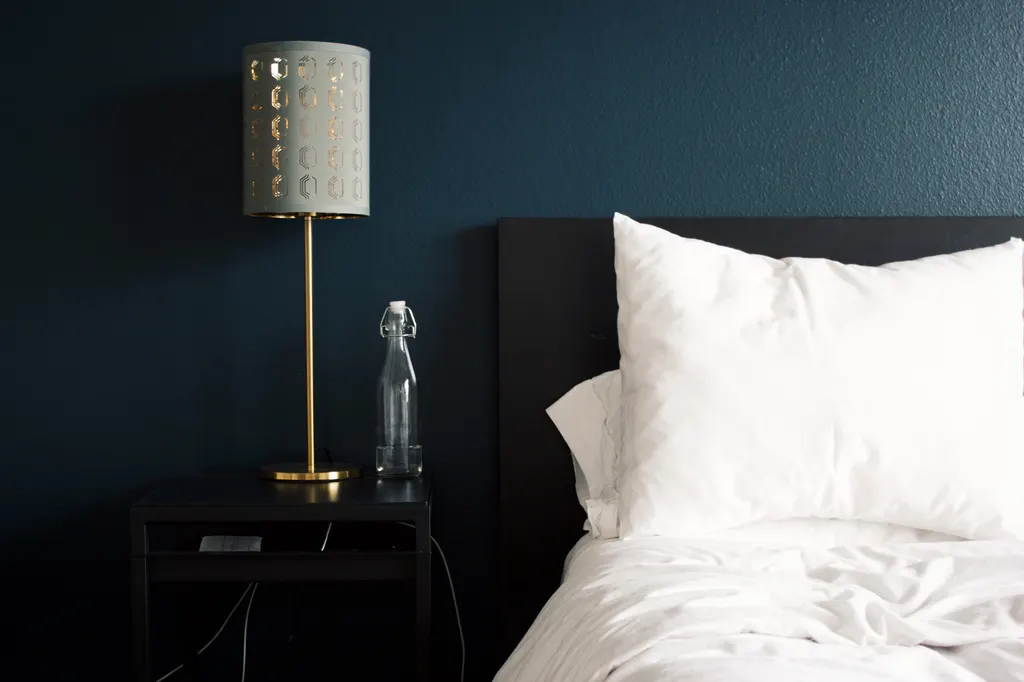
You got into bed at 11. You meant to check one thing. It's now 12:40, the video you're watching is about a stranger renovating a boat, and you know you'll regret this at 7.
The clocks went back in Europe this morning, and the US follows next Sunday. A lot of people will spend that "extra hour" exactly like this. So it's a good week to look at what the research says about phones in bed, because some of the most repeated advice turns out to be the least useful.
The short answer: the main cost of scrolling in bed is the time it takes from sleep. Blue light plays a smaller part than you've heard, and Night Shift made no measurable difference in a controlled trial. What did help: putting the phone away 30 minutes before bed.
It has a name: bedtime procrastination
In 2014, researchers at Utrecht University gave this habit a name. Bedtime procrastination means going to bed later than you intended when nothing is actually stopping you. No crying baby, no deadline. Just you, choosing another half hour of something.
They found it was more common in people with weaker self-regulation in general, and it predicted insufficient sleep even after accounting for that. Since then the internet has added a sharper version: revenge bedtime procrastination, staying up late to win back free time after a day that felt like it belonged to your boss, your kids, or your inbox.
That framing matters, because it explains why "just go to bed" doesn't work. The scrolling isn't random. It's the only part of the day that feels like yours. Any fix has to respect that, or you'll quietly undo it by Wednesday.
The real cost is time
The biggest recent study on this is a 2025 survey of 45,202 Norwegian university students. Each extra hour of screen use after getting into bed was linked to 59% higher odds of insomnia symptoms and 24 minutes less sleep.
The more interesting finding is what didn't matter. Social media wasn't worse for sleep than the other screen activities the students reported. If the problem were mainly that feeds wind you up, social media should have stood out. It didn't. The authors read this as evidence for a simpler explanation: screens in bed push sleep later because they take time, and the time comes out of your night.
One fair caveat. This was a survey taken at a single point in time, so it can't rule out the reverse: people who already sleep badly may reach for their phone because they can't sleep. Both are probably true for some people.
Blue light is a smaller problem than you've heard
The blue light story comes from real research. In a 2015 study at Brigham and Women's Hospital, 12 young adults read on an iPad for about four hours before bed, in a dim room, for five nights in a row. Compared with reading a printed book, they took nearly 10 minutes longer to fall asleep, released less melatonin, felt less sleepy at night, and were less alert the next morning.
That's a genuine effect, but look at the dose: four hours of a bright screen, five nights straight, with almost no other light in the room. Most of us don't read on a tablet for four hours before bed. We scroll for 40 minutes with the lights on.
When researchers tested the fix most people use, it didn't hold up. In a 2021 study of 167 young adults, participants were randomly assigned to use their iPhone with Night Shift on, use it with Night Shift off, or not use it at all in the hour before bed, for seven nights. Wrist sensors tracked their sleep. There were no significant differences between the three groups.
The one hint came from people who already slept more than about 6.8 hours a night. For them, no phone at all gave the best sleep, and Night Shift didn't close that gap. So Night Shift is fine to leave on, but it isn't permission to keep scrolling.
What worked: 30 minutes without the phone
The most direct test I've found is small but randomized. In a 2020 pilot trial, 38 people were split into two groups. One was asked to stop using their phone 30 minutes before bed for four weeks. The other got no instructions.
The phone-free group fell asleep faster, slept longer, rated their sleep better, felt less wound up before sleep, and did better on a working memory test. With 19 people per group it's a pilot, not the final word. But it lines up with the Norwegian data, and it points to a goal you can actually keep: not "no phones at night," just a phone-free last half hour.
An iPhone setup for tonight
The trick is to make the last 30 minutes phone-free without relying on willpower at 11 p.m., which is when you have the least of it.
- Pick a phone-down time, not just a bedtime. If you want to be asleep by 11:30, the phone goes down at 11. That's the number you're defending.
- Set Wind Down to start at that time. In the Health app, go to Browse → Sleep and set up a sleep schedule. Under Full Schedule & Options, set Wind Down to 30 minutes. Sleep Focus then turns on when Wind Down starts, silences notifications, and dims the Lock Screen.
- Charge the phone out of arm's reach. Across the room, or outside the bedroom if you can. Use a cheap alarm clock if the phone is your alarm. Nothing in the studies above tested this directly, but most late-night pickups are habit, not a response to anything, so every extra step between you and the phone is one more chance to not bother.
- Put the apps you scroll in bed behind a barrier. Downtime with a passcode someone else knows, or an app that adds a pause. My guide to reducing screen time on iPhone walks through both, including the PNAS study showing a pause cut app openings by 57%.
- Leave something else by the bed. A paper book or a magazine. In the eReader study, reading a printed book before bed didn't suppress melatonin at all. It also gives the "this time is mine" feeling somewhere to go.
Don't try to fix everything at once. If you're currently in bed with the phone until 1 a.m., a phone-down time of 12:30 is a win. Move it 15 minutes earlier each week.
Where breathing fits, honestly
Slow breathing gets recommended a lot for sleep, so it's worth being straight about it. In a 2020 sleep lab pilot, 20 young adults did 30 minutes of slow breathing or listened to music before bed. Both raised heart rate variability, a sign of the body settling down. But neither had a robust effect on sleep quality. Breathing calms you. It isn't a sleeping pill.
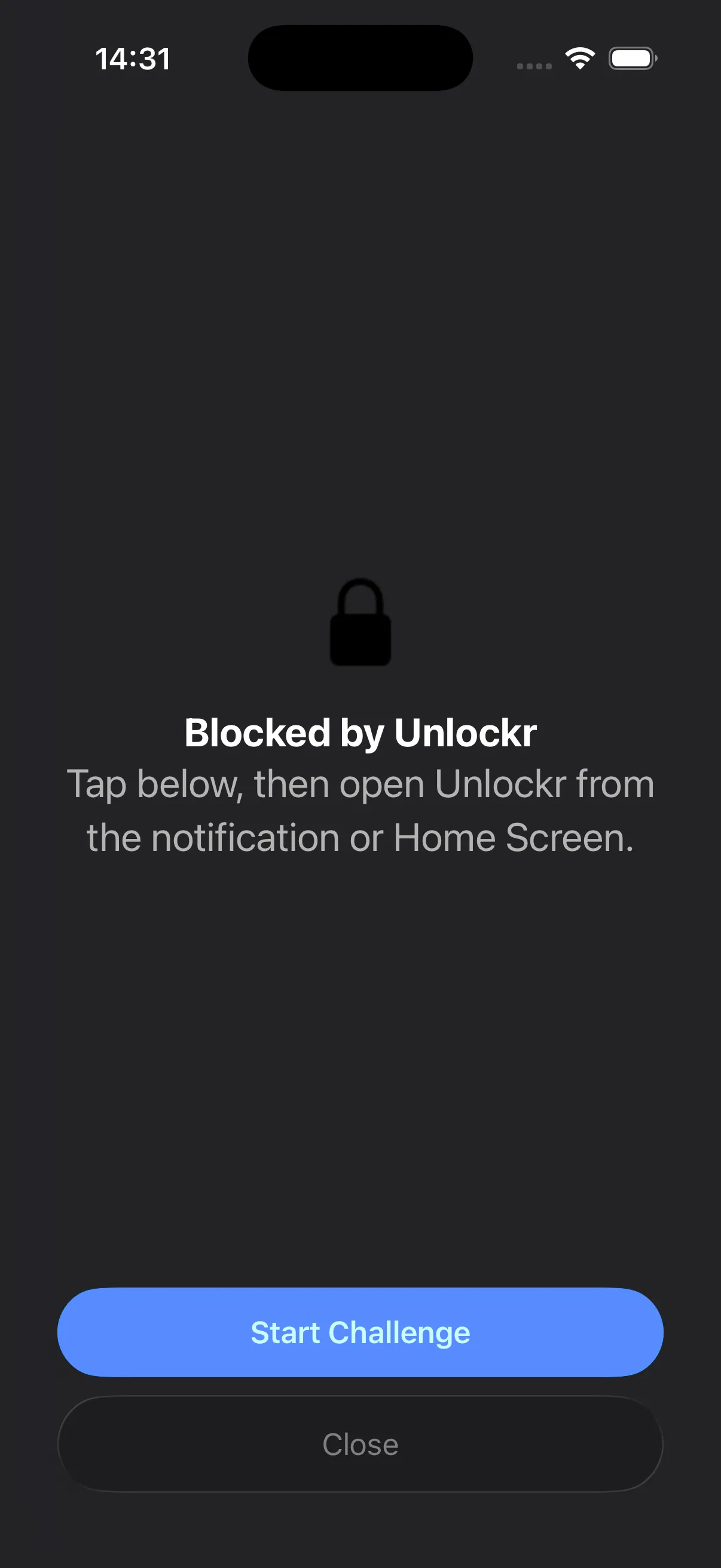
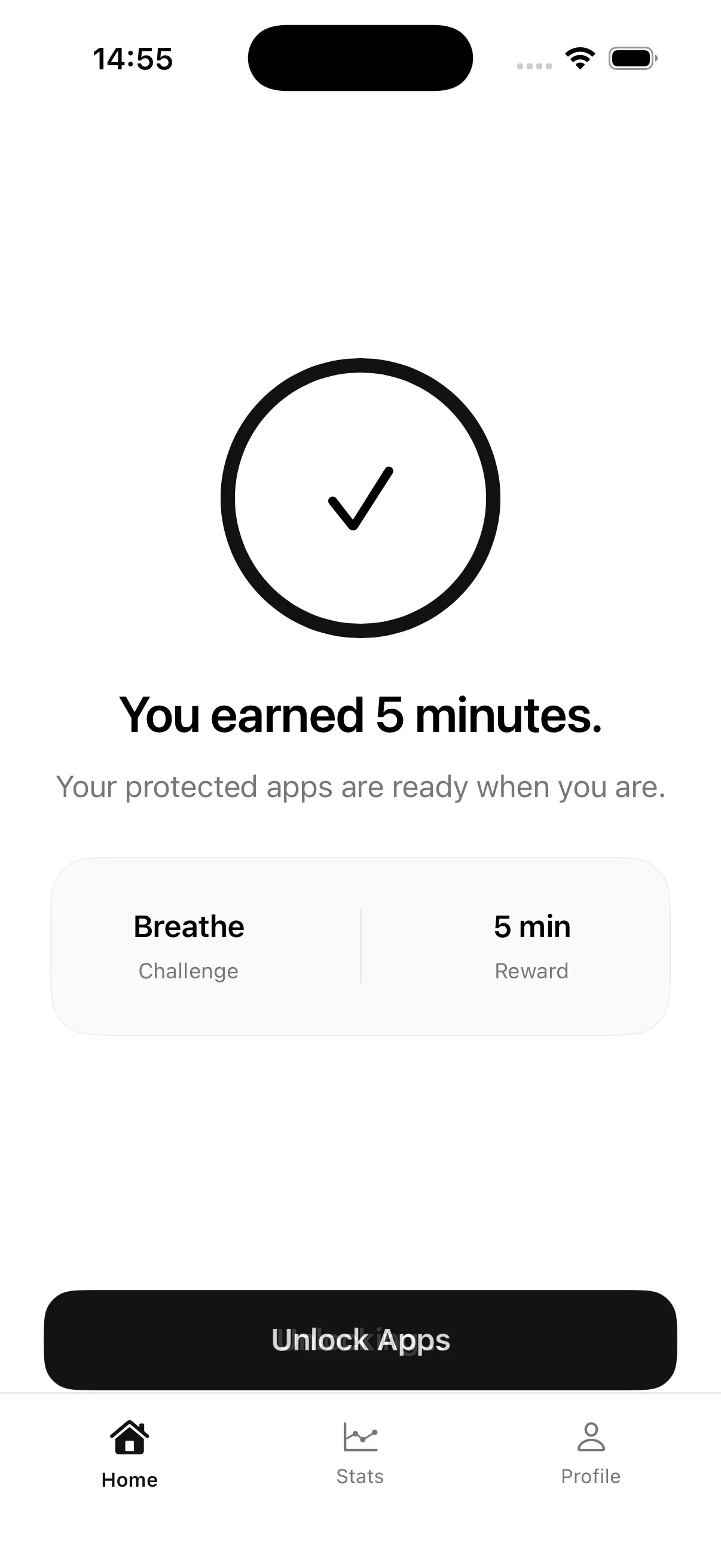
Where it helps is at the moment of decision. A disclosure: I build Unlockr, which puts a shield over the apps you choose. At 11:40, when you reach for Instagram, you get two ways in. A one-minute guided breathing exercise earns five minutes, which only count down while the app is actually open. Or 20 squats earn twenty minutes for one app, and 20 squats in your pajamas is a steep price for one more video, which is rather the point.
There's also a plain Close button. The idea is that a minute of slow breathing is long enough to notice you're tired and that the app can wait until morning. That's the design intent, not a trial result, so I won't put a number on it.
Frequently asked questions
Is it bad to use your phone in bed?
For most people, the cost is time. A 2025 survey of 45,202 Norwegian university students found that each extra hour of screen use after going to bed was linked to 59 percent higher odds of insomnia symptoms and 24 minutes less sleep. The study was cross-sectional, so it can't prove the phone caused the poor sleep.
Does Night Shift help you sleep?
Not measurably. In a 2021 study, 167 young adults were randomly assigned to use an iPhone with Night Shift, use it without Night Shift, or not use it in the hour before bed for seven nights. Sleep tracked by wrist sensors did not differ between the three groups.
How long before bed should I stop using my phone?
Thirty minutes is a reasonable, tested starting point. In a 2020 randomized pilot trial with 38 people, avoiding the phone for the 30 minutes before bed for four weeks shortened the time it took to fall asleep and increased sleep duration and sleep quality.
What is revenge bedtime procrastination?
It's staying up late on your phone or other leisure to claw back free time after a day that felt like it belonged to someone else. Researchers call the underlying behavior bedtime procrastination: going to bed later than you intended when nothing is stopping you.
Sources
- Kroese, F. M., De Ridder, D. T. D., Evers, C., & Adriaanse, M. A. (2014). Bedtime procrastination: Introducing a new area of procrastination. Frontiers in Psychology, 5, 611. doi.org/10.3389/fpsyg.2014.00611
- Hjetland, G. J., Skogen, J. C., Hysing, M., Gradisar, M., & Sivertsen, B. (2025). How and when screens are used: Comparing different screen activities and sleep in Norwegian university students. Frontiers in Psychiatry. doi.org/10.3389/fpsyt.2025.1548273
- Chang, A. M., Aeschbach, D., Duffy, J. F., & Czeisler, C. A. (2015). Evening use of light-emitting eReaders negatively affects sleep, circadian timing, and next-morning alertness. PNAS, 112(4), 1232–1237. doi.org/10.1073/pnas.1418490112
- Duraccio, K. M., Zaugg, K. K., Blackburn, R. C., & Jensen, C. D. (2021). Does iPhone Night Shift mitigate negative effects of smartphone use on sleep outcomes in emerging adults? Sleep Health. doi.org/10.1016/j.sleh.2021.03.005
- He, J.-W., Tu, Z.-H., Xiao, L., Su, T., & Tang, Y.-X. (2020). Effect of restricting bedtime mobile phone use on sleep, arousal, mood, and working memory: A randomized pilot trial. PLOS ONE, 15(2), e0228756. doi.org/10.1371/journal.pone.0228756
- Kuula, L., et al. (2020). The effects of presleep slow breathing and music listening on polysomnographic sleep measures: A pilot trial. Scientific Reports, 10, 7427. doi.org/10.1038/s41598-020-64218-7