 Unlockr
Does Exercise Actually Reduce Screen Time? What the Research Says
People who move more tend to struggle less with their phones, and people who cut their phone time start moving more. Here's what the studies show, where they stop, and how to use it without waiting for better data.

You get home, sit down for a second, and the phone is already in your hand. Forty minutes later you're still on the couch, and the walk you meant to take is now a "tomorrow" thing.
Anyone who has lived that evening can guess the two habits are connected. The interesting question is which way it runs. Does moving more make you reach for the phone less? Or does the phone just eat the time you would have spent moving? The research says both, with some important gaps.
The short answer: yes, probably, but not by magic. Exercise programs lower phone addiction scores in randomized trials, mostly in students. Cutting phone time by an hour a day makes people more active, and the cut tends to stick. What nobody has tested yet is whether a quick workout right before you open an app changes what happens next.
People who move more have less trouble with their phones
The biggest pile of evidence is correlational. A 2025 meta-analysis pooled 29 studies covering 54,039 college students and found a moderate negative link between physical activity and phone addiction: r = -0.35. Students who were more active scored lower on problematic phone use.
An r of -0.35 is a real relationship, not a law of nature. Plenty of active people are glued to their phones, and plenty of inactive people aren't. The bigger limits are in the fine print: every study in that analysis was cross-sectional, so it can't say which came first, and 25 of the 29 were from China.
There's a hint about direction from an older, smaller study. Lepp and colleagues tested the fitness of 49 US college students on a treadmill. More phone use went with lower cardiorespiratory fitness, and the heavy users were more likely to say they skipped chances to be active so they could stay on their phones.
Exercise programs lower phone addiction scores
Correlation is where most articles on this topic stop. But there are actual trials. A 2025 network meta-analysis combined 32 randomized controlled trials with 2,891 teenagers and young adults who scored high on phone addiction. The interventions ranged from badminton, basketball, aerobics, tai chi, and yoga to mindfulness and group counseling.
Pooled together, the interventions clearly beat doing nothing. In the ranking, badminton came out on top, with mindfulness, baduanjin (a Chinese qigong routine), and group counseling behind it. I wouldn't read much into badminton specifically. Few trials tested it, and the authors flag the top-ranked results as the least certain.
The caveats are worth knowing before you quote this at anyone. The trials were mostly Chinese university students, the results varied enormously between studies, and blinding was weak, which is hard to avoid when the intervention is "play badminton." The outcome was also a questionnaire score, not minutes of screen time.
Cutting phone time makes people move more
The cleanest experiment runs in the opposite direction. In a 2022 study from Ruhr University Bochum, 619 people were randomly split into three groups for a week: no smartphone at all, one hour less per day, or no change.
Both reduction groups ended up more physically active and more satisfied with life, with fewer symptoms of depression and anxiety. The one-hour group did best over time. Four months later they were still using their phones about 45 minutes less per day than before the study. Quitting entirely helped too, but the effects were less stable. A modest, specific cut beat going cold turkey.
A looser real-world version happened in Brest, France, in November 2022, when the city ran a "put down your smartphones" challenge. Researchers surveyed 490 participants before and after. The 126 who managed to cut at least an hour a day dropped their phone use by about 110 minutes and walked about 840 more steps a day on average. The spread between people was huge and there was no control group, so treat it as a field report, not proof.
The pattern makes sense once you notice that phone time is mostly sitting time. An hour not spent scrolling has to go somewhere, and for a lot of people some of it goes to walking.
Exercise alone won't fix the phone habit
The most useful study for anyone hoping a gym membership will solve their screen time comes from the same Bochum group. In a 2024 experiment with 278 employees, people were assigned to use their phones an hour less per day, exercise 30 minutes more per day, do both, or change nothing, for one week.
All three interventions lowered depressive symptoms and gave people a stronger sense of control. But the drop in problematic smartphone use, along with the gains in work satisfaction and work-life balance, showed up in the groups that cut their phone time: the phone-only group and the combination group.
So exercise makes you feel better, and feeling better probably helps. But if the phone habit itself is the problem, you have to aim something at the phone.
Why movement might help
There are three plausible mechanisms, with different amounts of evidence behind each.
It takes up the same time. This one is almost arithmetic. Most phone use is sedentary leisure. Time spent moving can't also be spent scrolling, and the Bochum results suggest the swap works in both directions.
It changes the mood that sends you to the phone. A lot of checking isn't about wanting something on the phone. It's about escaping boredom, stress, or a task you don't want to start. Exercise is one of the more reliable ways to shift those states. There's a striking parallel in smoking research: a systematic review of 12 studies found that a single bout of exercise reduced cigarette cravings, with the effect lasting up to 50 minutes afterward. Checking your phone is not nicotine, and as far as I know no one has run this test on phone urges. But the idea that a short burst of movement takes the edge off an urge has real support.
It puts a pause before the app. This is the mechanism with the strongest evidence, even though it isn't about exercise at all. In the one sec field experiment published in PNAS, a short forced pause before opening a chosen app, plus an easy way to back out, cut how often people actually opened those apps by 57% after six weeks. I covered that study in more detail in my guide to reducing screen time on iPhone. A set of squats is a pause, just a more demanding one.
What the research doesn't show yet
Being honest about the gaps:
- No one has tested "exercise to unlock." The trials used weeks-long exercise programs, not 20 squats in front of Instagram. Whether a short burst right before an app works better than a plain pause is an open question.
- The outcomes are mostly questionnaires. Phone addiction scales measure how you feel about your phone use. Few studies measured actual minutes or pickups.
- The populations are narrow. Most trials are Chinese university students. The Bochum studies are German adults. Results may differ for a 40-year-old parent in Texas.
- The dose is unknown. Nobody can tell you how many minutes of exercise buy how many fewer minutes of scrolling.
| Claim | Best evidence | How strong |
|---|---|---|
| Active people have less problematic phone use | Meta-analysis, 29 studies, 54,039 students | Consistent, but correlation only |
| Exercise programs reduce phone addiction | Network meta-analysis, 32 RCTs | Moderate, mostly one country |
| Cutting phone time increases activity | Randomized experiment, 619 adults | Good, with four-month follow-up |
| Exercise alone reduces problematic phone use | Randomized experiment, 278 employees | Not shown; cutting phone time did |
| A pause before the app cuts app openings | Field experiment, 280 users, PNAS | Strong |
| Exercise right before an app cuts use | None yet | Untested |
How to use this today
You don't need to wait for the perfect trial. The pieces that are well supported already point to a plan.
- Cut one specific hour, not "less." The one-hour group in the Bochum study kept their gains longer than the group that quit entirely. Pick the hour that costs you most, usually right after work or right before bed.
- Fill that hour with something that moves. A walk, a sport, chores you've been avoiding. The point is that the time has somewhere to go.
- Aim directly at the app, too. Exercise alone didn't fix problematic phone use in the 2024 study. Put a pause in front of the one app you open most after you pick up your phone.
- Make the pause physical if you can. Ten squats before opening TikTok might not reduce your screen time more than a ten-second wait. Nobody knows yet. But it won't do less for your body.
- Measure pickups, not just hours. In Settings → Screen Time, write down your pickups and your top "first used" app. Check again in a week.
On point 4, short bursts count for more than they seem. In a 2022 study of 25,241 adults who didn't exercise, wearing wrist trackers, those who got about three bursts of vigorous activity a day, each one to two minutes long, had a 38 to 40 percent lower risk of dying from any cause over the following years. That's an observational link, not a guarantee. Still, a few hard minutes spread through the day isn't nothing.
Where Unlockr fits
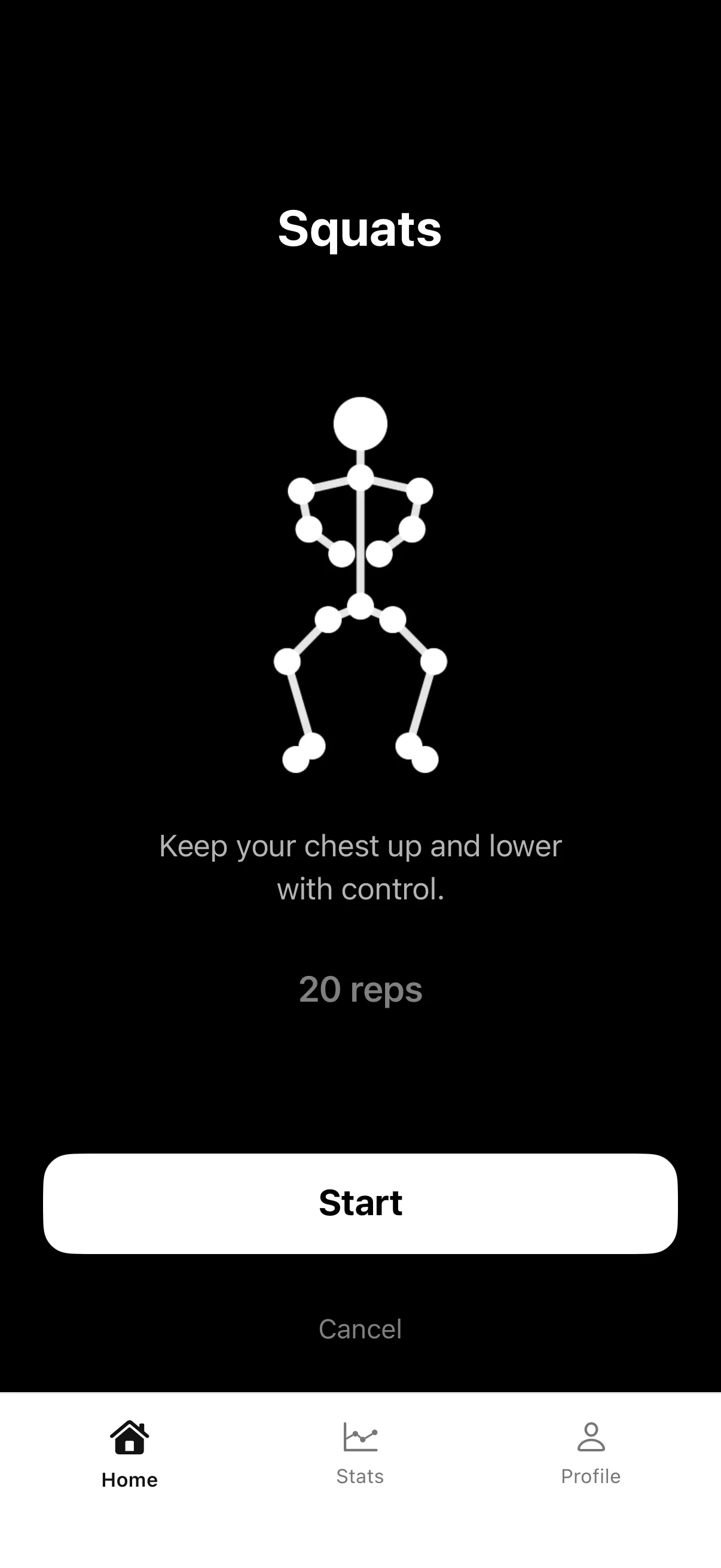
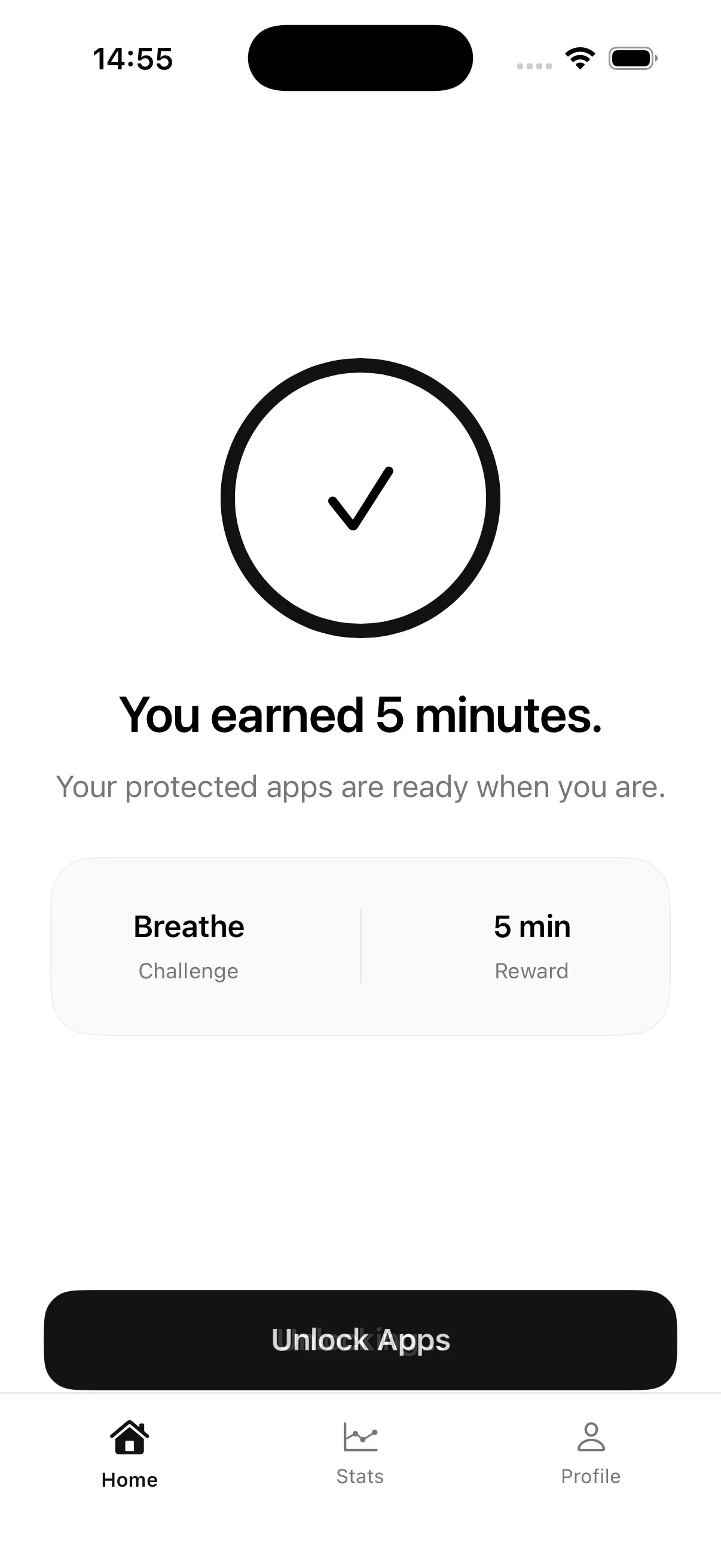
Disclosure: I build Unlockr, and it exists because of the research above. It puts a shield over the apps you choose. To get back in, you either breathe for a guided minute, which earns five minutes for all your locked apps, or do a set of squats, push-ups, or a plank, which earns twenty minutes for the app you picked. The camera counts reps on your iPhone, and no video leaves the device.
The shield also has a plain Close button, the "easy way out" that did the most work in the one sec study. Often the best outcome is that you look at the squat count, decide the app isn't worth it, and close it.
Unlockr hasn't been tested in a trial, so I can't promise it cuts your screen time by a particular amount. What it combines are the two parts with the best support: friction before the app, and more movement in your day.
Frequently asked questions
Does exercise reduce phone addiction?
Probably, though the evidence is mostly from young people in China. A 2025 network meta-analysis of 32 randomized trials (2,891 participants) found that exercise programs reduced phone addiction scores compared with doing nothing. A separate 2025 meta-analysis of 29 cross-sectional studies (54,039 students) found a moderate link between more physical activity and less problematic phone use (r = -0.35).
Does cutting screen time make you more active?
It seems to. In a 2022 experiment with 619 people, those asked to use their phone one hour less per day for a week spent more time being physically active, and four months later were still using their phone about 45 minutes less per day than before.
How much exercise do I need to use my phone less?
Nobody knows the dose yet. The trials used structured programs over several weeks and measured addiction questionnaires, not minutes on screen. Short bouts still count for your health: in a 2022 study of 25,241 non-exercisers, about three 1 to 2 minute bursts of vigorous activity a day was linked to 38 to 40 percent lower all-cause mortality.
Is there an app that makes you exercise before you can use your phone?
Yes. Unlockr for iPhone keeps the apps you choose behind a shield until you finish a one-minute breathing exercise or a set of squats, push-ups, or a plank counted on-device by the camera. The time you earn only counts down while the unlocked app is open.
Sources
- Yu, L., Chen, Z., Huang, X., Tao, X., & Lv, Y. (2025). The relationship between physical activity and mobile phone addiction in college students: A systematic review and meta-analysis. Behavioral Sciences, 15(10), 1325. doi.org/10.3390/bs15101325
- Li, Y., et al. (2025). The influence of different intervention measures on improving mobile phone addiction among teenagers or young adults: A systematic review and network meta-analysis. Frontiers in Psychiatry, 16, 1629251. doi.org/10.3389/fpsyt.2025.1629251
- Brailovskaia, J., et al. (2022). Finding the "sweet spot" of smartphone use: Reduction or abstinence to increase well-being and healthy lifestyle?! Journal of Experimental Psychology: Applied. doi.org/10.1037/xap0000430
- Le Steunf, A., Page, E., Guillodo, Y., & Saraux, A. (2024). Does reducing smartphone use impact physical activity? PLOS ONE, 19(10), e0311248. doi.org/10.1371/journal.pone.0311248
- Brailovskaia, J., Siegel, J., Precht, L.-M., Friedrichs, S., Schillack, H., & Margraf, J. (2024). Less smartphone and more physical activity for a better work satisfaction, motivation, work-life balance, and mental health: An experimental intervention study. Acta Psychologica, 250, 104494. doi.org/10.1016/j.actpsy.2024.104494
- Lepp, A., Barkley, J. E., Sanders, G. J., Rebold, M., & Gates, P. (2013). The relationship between cell phone use, physical and sedentary activity, and cardiorespiratory fitness in a sample of U.S. college students. International Journal of Behavioral Nutrition and Physical Activity, 10, 79. doi.org/10.1186/1479-5868-10-79
- Taylor, A. H., Ussher, M. H., & Faulkner, G. (2007). The acute effects of exercise on cigarette cravings, withdrawal symptoms, affect and smoking behaviour: A systematic review. Addiction, 102(4), 534–543. doi.org/10.1111/j.1360-0443.2006.01739.x
- Grüning, D. J., Riedel, F., & Lorenz-Spreen, P. (2023). Directing smartphone use through the self-nudge app one sec. PNAS. doi.org/10.1073/pnas.2213114120
- Stamatakis, E., et al. (2022). Association of wearable device-measured vigorous intermittent lifestyle physical activity with mortality. Nature Medicine. doi.org/10.1038/s41591-022-02100-x